


A serious trading card collection does not have to look serious
There is a version of collecting where every card is supposed to prove something. The athlete has to be legendary. The character has to be important. The grade has to be high. The value has to make sense. The card has to look like it belongs in a portfolio presentation.
I understand that kind of collecting. It is just not enough for me.
My collection has Michael Jordan, Marvel PMGs, Black Panther, Jackie Robinson, vintage material and genuinely scarce cards. It also has SpongeBob.
That is not a contradiction. It is probably one of the most accurate things about the collection.
Why SpongeBob belongs in collector culture
SpongeBob has been part of popular culture for decades. The character is instantly recognizable, the humor is strange in exactly the right way, and the visual world works on a trading card because it is bold, simple and full of personality.
I do not need to turn that into a complicated investment thesis. I like SpongeBob. I think the card looks good. The image makes me laugh. That is already a valid collecting reason.
Sometimes collectors spend so much time trying to justify a card that they forget the original hobby logic: you are allowed to own something because it is cool to you.
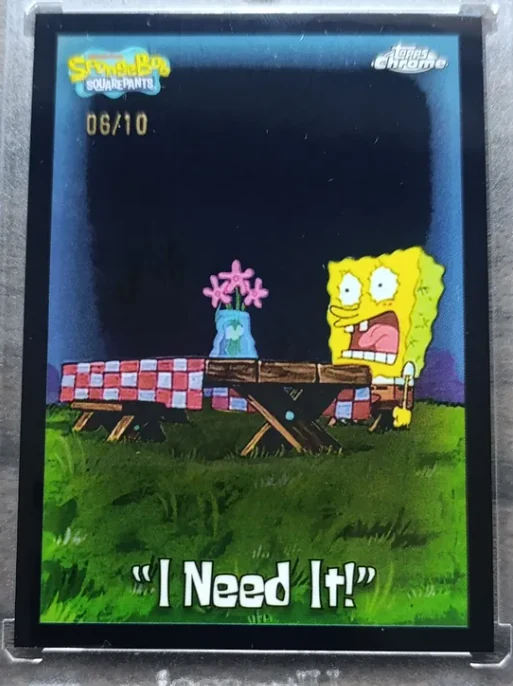
Then add scarcity: a SpongeBob card numbered to 10
The fact that my “I Need It!” card is numbered to 10 adds another layer. Now the card is funny and genuinely scarce at the same time.
That combination is interesting because it breaks the usual hierarchy. Scarcity is often discussed with a very serious tone, especially when the subject is a blue-chip athlete or major superhero. Put a serial number on SpongeBob and suddenly the same hobby mechanics feel slightly absurd.
I love that.
The /10 does matter because it makes the card difficult to replace. But, just like with the rest of my collection, scarcity only works because I already enjoy the object.
Weird cards reveal the collector better than safe cards do
If every card in a collection is universally approved, you learn very little about the person who built it.
The strange card is often more revealing. The oddball insert, the cartoon, the obscure vintage piece, the card bought because of artwork rather than status — those choices show taste.
A numbered SpongeBob card sitting next to Jordan and Marvel PMGs tells you that I am not trying to build a museum according to somebody else's rules. I am building a collection that reflects what I actually like.
Humor is part of nostalgia too
Nostalgia does not only mean serious childhood memories. It includes the things that made you laugh, the cartoons you watched, the characters everybody knew and the images that instantly take you back to a certain era.
That is why non-sports cards can be so powerful. They archive culture differently than sports cards do. They capture characters, jokes, television, comics, films and all the other things that lived alongside sport in our lives.
Can a funny card be a grail?
For me, yes — because my definition of a grail is personal.
A grail does not need to be the most expensive card in the room. It can be something you searched for, something difficult to replace, something visually perfect for your taste or something that makes no sense to anybody else but immediately makes sense to you.
The SpongeBob card is exactly the kind of piece that keeps a collection from becoming too predictable.
Collector-first means allowing contradictions
I like serious cards. I like rare cards. I like history. I like Jordan, Jackie Robinson and Black Panther. I also like shiny Marvel cards and ridiculous cartoons.
Those interests do not cancel each other out. They make the collection mine.
That is the collector-first idea behind DAH'VEED: the collection should follow your taste before it follows somebody else's category system.
Collector take: if it makes you smile, that can be enough
The hobby can become very analytical very quickly. Prices, grades, populations, scarcity, liquidity. All useful information.
But there should still be room for a card that makes you look at it and think, “That is hilarious. I want that.”
Sometimes the weird card is the one that makes the whole collection feel human.
And sometimes “because I like it” is the best reason in the hobby.
Eine ernsthafte Trading-Card-Sammlung muss nicht ernst aussehen
Es gibt eine Art zu sammeln, bei der jede Karte etwas beweisen soll. Der Athlet muss legendär sein. Der Charakter muss wichtig sein. Das Grade muss hoch sein. Der Wert muss Sinn ergeben. Die Karte soll aussehen, als würde sie in eine Portfolio-Präsentation gehören.
Ich verstehe diese Art zu sammeln. Mir reicht sie nur nicht.
In meiner Sammlung stehen Michael Jordan, Marvel PMGs, Black Panther, Jackie Robinson, Vintage-Material und wirklich seltene Karten. Und SpongeBob.
Das ist kein Widerspruch. Wahrscheinlich beschreibt es meine Sammlung sogar ziemlich gut.
Warum SpongeBob in Collector Culture gehört
SpongeBob ist seit Jahrzehnten Teil der Popkultur. Die Figur erkennt jeder sofort, der Humor ist auf genau die richtige Art schräg, und die visuelle Welt funktioniert auf einer Trading Card, weil sie laut, klar und voller Persönlichkeit ist.
Ich muss daraus keine komplizierte Investment-These machen. Ich mag SpongeBob. Ich finde die Karte optisch stark. Das Bild bringt mich zum Lachen. Das ist bereits ein gültiger Sammelgrund.
Manchmal verbringen Sammler so viel Zeit damit, eine Karte zu rechtfertigen, dass sie die ursprüngliche Hobby-Logik vergessen: Du darfst etwas besitzen, einfach weil du es cool findest.
Und dann kommt Seltenheit dazu: eine SpongeBob-Karte /10
Dass meine „I Need It!“-Karte auf 10 Exemplare nummeriert ist, legt noch eine Ebene darüber. Jetzt ist die Karte gleichzeitig lustig und wirklich selten.
Genau diese Kombination finde ich spannend, weil sie die typische Hierarchie bricht. Über Seltenheit wird oft sehr ernst gesprochen, besonders bei Blue-Chip-Athleten oder großen Superhelden. Gib SpongeBob eine Seriennummer, und dieselben Hobby-Mechaniken wirken plötzlich leicht absurd.
Das liebe ich.
Die /10 ist relevant, weil sie die Karte schwer ersetzbar macht. Aber wie bei meiner restlichen Sammlung funktioniert Seltenheit nur deshalb, weil ich das Objekt vorher schon mag.
Schräge Karten zeigen den Collector oft besser als sichere Picks
Wenn jede Karte in einer Sammlung universell abgesegnet ist, erfährt man erstaunlich wenig über die Person, die sie aufgebaut hat.
Die komische Karte verrät oft mehr. Das Oddball-Insert, der Cartoon, das obskure Vintage-Stück, die Karte, die wegen Artwork statt Status gekauft wurde – solche Entscheidungen zeigen Geschmack.
Eine nummerierte SpongeBob-Karte neben Jordan und Marvel PMGs zeigt, dass ich kein Museum nach den Regeln anderer bauen will. Ich baue eine Sammlung, die zeigt, was ich tatsächlich mag.
Humor ist auch Nostalgie
Nostalgie besteht nicht nur aus ernsten Kindheitserinnerungen. Dazu gehören auch Dinge, über die man gelacht hat, Cartoons, die man gesehen hat, Figuren, die jeder kannte, und Bilder, die einen sofort in eine bestimmte Zeit zurückwerfen.
Genau deshalb können Non-Sports-Karten so stark sein. Sie archivieren Kultur anders als Sportkarten. Sie halten Figuren, Witze, Fernsehen, Comics, Filme und all die anderen Dinge fest, die neben Sport Teil unseres Lebens waren.
Kann eine lustige Karte ein Grail sein?
Für mich: ja. Denn meine Grail-Definition ist persönlich.
Ein Grail muss nicht die teuerste Karte im Raum sein. Es kann etwas sein, nach dem du lange gesucht hast, etwas schwer Ersetzbares, etwas visuell Perfektes für deinen Geschmack oder etwas, das für andere keinen Sinn ergibt und für dich sofort.
Die SpongeBob-Karte ist genau so ein Stück, das verhindert, dass eine Sammlung zu vorhersehbar wird.
Collector First heißt auch, Widersprüche zuzulassen
Ich mag ernste Karten. Ich mag seltene Karten. Ich mag Geschichte. Ich mag Jordan, Jackie Robinson und Black Panther. Ich mag aber genauso glänzende Marvel-Karten und alberne Cartoons.
Diese Interessen widersprechen sich nicht. Sie machen die Sammlung zu meiner.
Genau das ist die Collector-First-Idee hinter DAH'VEED: Die Sammlung soll zuerst deinem Geschmack folgen und erst danach den Kategorien anderer.
Collector Take: Wenn dich eine Karte zum Grinsen bringt, kann das reichen
Das Hobby wird sehr schnell analytisch. Preise, Grades, Populations, Seltenheit, Liquidität. Alles nützliche Informationen.
Aber es sollte immer noch Platz für eine Karte geben, bei der du einfach denkst: „Das ist so bescheuert – die will ich.“
Manchmal ist genau die schräge Karte das, was eine Sammlung menschlich macht.
Und manchmal ist „weil ich sie mag“ der beste Grund im ganzen Hobby.